TL;DR

Get oils, diffusers and self-care delivered free — and shop member deals
- Fast, free delivery on millions of items
- Access to Prime Big Deal Days deals on October 6–7
- Prime Video, Amazon Music and more included
Tai Chi teacher Brian Thompson shared a four-part, five-minute morning routine in a Fit&Well report. The sequence combines self-massage, arm movements, weight shifts and breathing; claims that it can ease tension or improve focus come from Thompson, and the report provides no study or outcome data.
Tai Chi teacher Brian Thompson has shared a four-part morning routine lasting about five minutes, with movements intended to ease into the day through gentle motion and steady breathing. The sequence, published by Fit&Well, offers readers a short set of instructions; its proposed effects on tension, energy and focus are Thompson’s claims, not outcomes established in the report by research or measurement.
The routine begins seated, either on a chair or at the edge of a bed. Participants massage their neck, arms, midsection and legs, then cup their hands and pat gently along the shoulders, arms, chest, torso and legs. Thompson advises keeping an upright but relaxed posture and using a soft tapping motion rather than striking the body hard.
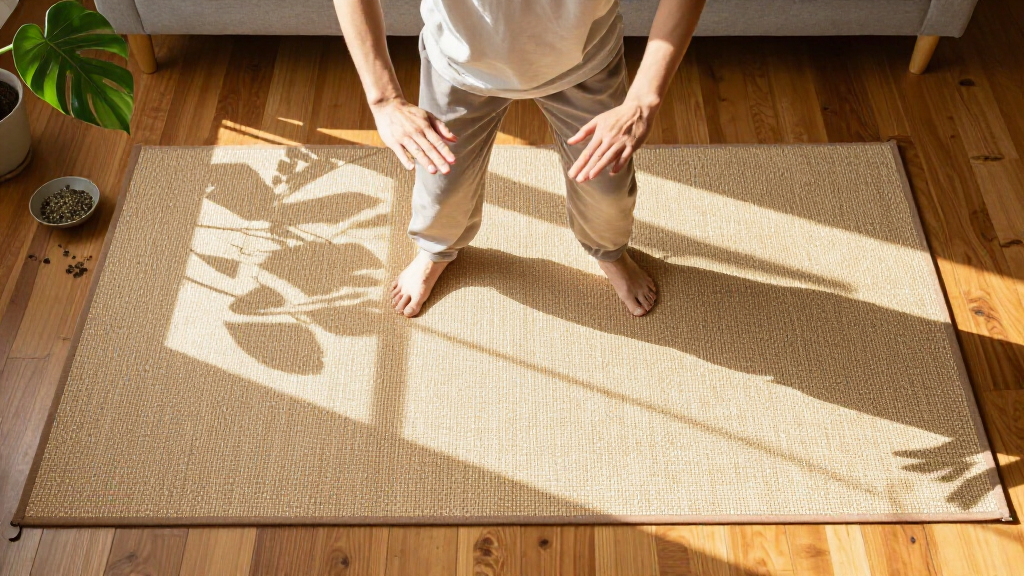
The second movement, called “Lifting water,” is done standing with feet about shoulder-width apart and knees slightly bent. Practitioners raise relaxed arms to shoulder height while inhaling, then lower them with soft elbows while exhaling through the nose for a count of at least four. Fit&Well suggests three to five repetitions and keeping the knees aligned with the feet.
The final movements are a slow, alternating “silk reeling” weight shift and “gather and release.” Silk reeling coordinates waist turns, a hand moving across the body and shifts between bent knees; the routine then has practitioners raise both arms overhead and lower them in a wave-like motion, for three to five repetitions. The report emphasizes smooth movement, soft joints and nasal breathing throughout.
A Short Routine for Starting the Day
The routine gives readers a structured sequence that takes about five minutes and can begin seated before moving to standing exercises. Its practical focus is gentle mobility and attention to breathing, with no equipment described as necessary. That may make the instructions accessible to people seeking a brief movement break after waking.
Thompson says morning Tai Chi may help wake stiff joints, increase energy and support a calmer, more focused mindset. Those are attributed expectations: the supplied report does not cite a clinical trial, compare this sequence with other routines, or provide evidence that five minutes produces those results for everyone.
Thompson’s Tai Chi Guidance
Fit&Well describes Tai Chi as a mindful movement practice built around slow, intentional exercises. The report identifies Thompson as a Tai Chi teacher and founder of bnew4life, and presents the sequence as his go-to practice for mornings. It also notes that Tai Chi can be practiced at other times of day.
Thompson’s instructions combine self-massage and Qigong body cupping with movements named “Lifting water,” “silk reeling” (chan si gong), and “gather and release.” The report offers posture and breathing cues for each exercise, but does not give a full video, individualized modifications or a description of Thompson’s training credentials beyond his identification as a teacher.
“It works to gently release deep-seated joint stiffness, muscle tightness, and mental stress.”
— Brian Thompson, Tai Chi teacher
Benefits and Adaptations Unspecified
The Fit&Well report does not provide research findings or outcome measurements for this particular routine. It is not clear how much the sequence affects stiffness, stress, energy or concentration, or whether those effects vary by person. The article also does not specify modifications for people with limited mobility, balance concerns or existing joint conditions.
Thompson’s benefit statements should be read as his guidance rather than a guarantee. The provided material does not state whether the routine has been assessed by an independent expert or tested as a five-minute program.
How Readers Can Try the Sequence
The report gives readers the order, repetition guidance and movement cues needed to try the practice: begin seated with self-massage and gentle tapping, then move through Lifting water, silk reeling and gather and release. Thompson advises keeping the motions slow and continuous and avoiding locked joints.
No follow-up study, additional instruction or planned next milestone is identified in the source material. Readers who try the movements can follow the cues while staying within a comfortable range of motion; anyone with a health condition or uncertainty about exercise suitability can seek guidance from a qualified health professional.
Key Questions
How long does the morning Tai Chi routine take?
The sequence is presented as a five-minute practice. The report does not specify exact timings for each of its four parts.What movements are included?
It includes seated self-massage and gentle hand cupping, “Lifting water,” alternating silk reeling, and the gather-and-release arm movement.Does the report prove the routine improves focus or relieves tension?
No. Those potential benefits are claims made by Thompson; the report provides no study results or measurements for this specific sequence.Can the routine be done at another time of day?
Yes. The report says Tai Chi can be practiced at any time, while Thompson describes a morning session as a way to begin the day with calm movement and breathing.Source: rss
Evergreen bestsellers Picks
bestsellers
As an affiliate, we earn on qualifying purchases.