Ancient herbology texts like the Egyptian Ebers Papyrus, Chinese Huangdi Neijing, and Greek Dioscorides’ De Materia lay the groundwork for modern medicine. These sources organized herbal knowledge, classified plants, and introduced principles still used today. They combined practical observation with holistic healing methods, shaping drug development and herbal therapy protocols. Their influence extends into contemporary pharmacology and natural medicine, revealing that many remedies and classifications originated thousands of years ago. You’ll uncover how these texts continue to impact health practices now.

Get oils, diffusers and self-care delivered free with Prime
- Fast, free delivery on millions of items
- Prime Video, Amazon Music and more included
- Member-only deals all year
Key Takeaways
- The Ebers Papyrus (Egypt, 1550 BCE) documented herbal remedies and early medical practices, emphasizing natural treatments.
- The Huangdi Neijing (China) established principles of Traditional Chinese Medicine, focusing on Qi, Yin-Yang balance, and holistic health.
- Dioscorides’ De Materia organized herbs by effects and parts used, influencing herbal classification and pharmacology for centuries.
- The Canon of Medicine by Avicenna standardized herbal descriptions, merging theory and practice, impacting Islamic and European medicine.
- Pliny the Elder’s *Natural History* cataloged plants, minerals, and animals, linking botanical knowledge with practical medicine across cultures.
Products Worth Considering

Oura Ring 5 Smart Ring, Silver, Size 10

Garmin Forerunner 165 GPS Running Smartwatch, 43 mm, Black

Therabody Theragun Relief Massage Gun, 3-Speed, Black
As an affiliate, we earn on qualifying purchases.
The Significance of the Ebers Papyrus in Ancient Healing
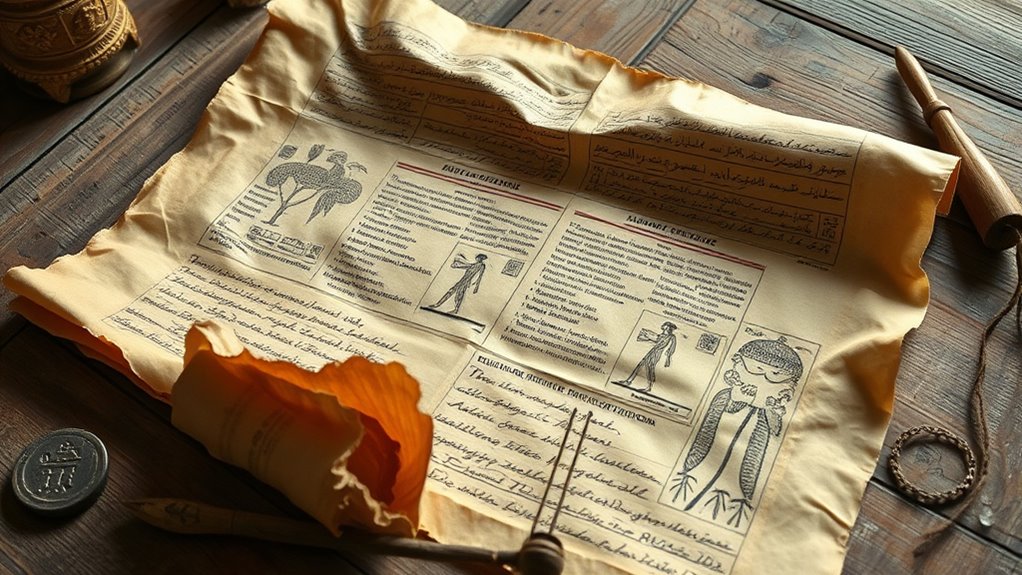
The Ebers Papyrus stands as one of the most important ancient medical texts, offering a detailed glimpse into early healing practices. You can see how ancient Egyptians understood health and disease, using a combination of herbal remedies, magic, and practical treatments. This papyrus, dating back to around 1550 BCE, covers everything from treating wounds to digestive issues. It reflects a sophisticated approach to medicine, blending scientific observation with spiritual beliefs. As you study it, you’ll notice the emphasis on herbal treatments and the importance placed on natural remedies. Its detailed descriptions helped shape the foundation of medical knowledge for centuries and influenced later civilizations. The Ebers Papyrus remains a crucial link to understanding how early healers approached health and disease management.
The Role of the Dioscorides’ De Materia in Herbal Medicine
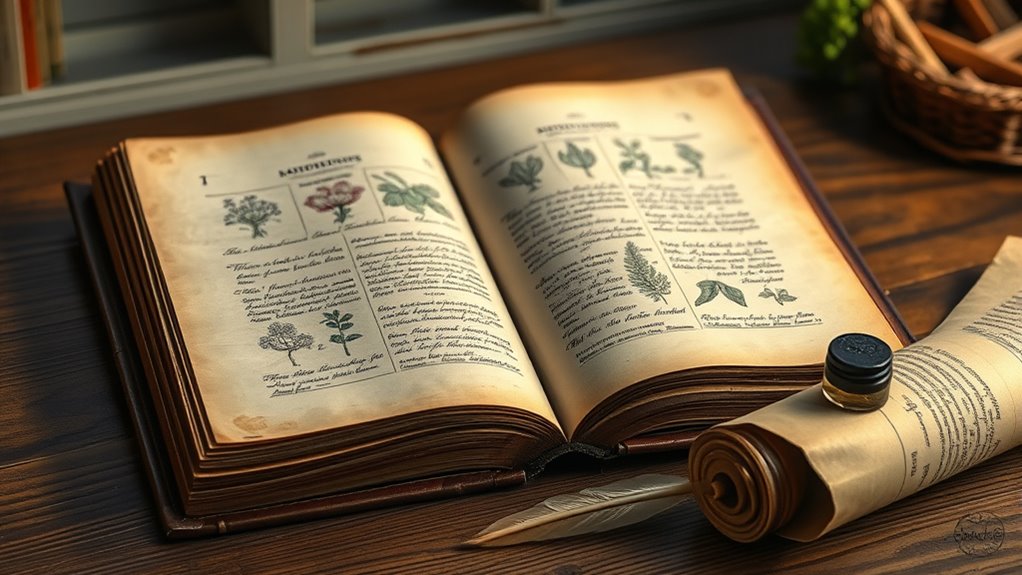
You recognize that De Materia is a foundational text that shaped herbal medicine for centuries. Its classifications and descriptions of plants helped practitioners understand their uses and effects. Today, its influence continues to inform modern pharmacology and herbal research.
Historical Significance of De Materia
Dioscorides’ De Materia has profoundly shaped herbal medicine by serving as one of the earliest and most extensive texts on medicinal plants. It provided a thorough reference for centuries, influencing both ancient and medieval practices. Your understanding of herbal remedies stems from its detailed descriptions of plants, their properties, and uses. This work set the foundation for botanical classification and medicinal knowledge, bridging cultures and eras. The table below highlights its enduring impact:
| Contribution | Significance |
|---|---|
| Standardized plant descriptions | Allowed consistent identification across regions |
| Influenced medical texts | Became a core reference in European herbalism |
| Spread herbal knowledge | Facilitated knowledge transfer across civilizations |
| Preserved ancient practices | Ensured survival of herbal traditions |
| Shaped modern herbal studies | Continues to inform contemporary herbal medicine |
Herbal Classifications and Uses
Building on the enduring influence of De Materia, its detailed classifications of herbs laid the groundwork for understanding plant properties and their medicinal uses. You see, Dioscorides organized herbs based on their effects, parts used, and healing qualities, which helped practitioners identify plants for specific ailments. His system categorized herbs into groups like culinary, medicinal, or toxic, making it easier to determine their purpose. This classification system also guided herbal preparation, dosage, and application. By understanding these categories, you can appreciate how ancient healers linked plant traits to health benefits. De Materia’s detailed descriptions and classifications formed a practical framework that shaped herbal medicine practices for centuries, and its influence remains evident in how we evaluate and use medicinal plants today.
Influence on Modern Pharmacology
The influence of De Materia on modern pharmacology is profound, as its detailed herbal classifications and descriptions laid the foundation for contemporary drug development and herbal medicine. You can trace many herbal remedies today back to Dioscorides’ work, which systematically organized plants based on their medicinal properties. This text introduced a standardized approach that helped pharmacists and physicians identify, compare, and use herbs more effectively. Its detailed illustrations and precise descriptions improved accuracy in herbal identification, reducing errors. Modern pharmacology still relies on these early classifications to explore plant-based compounds. Dioscorides’ influence also encouraged the integration of herbal knowledge into scientific research, shaping how we discover and develop new medicines today. His work remains a cornerstone in the history of herbal medicine and pharmacology.
Traditional Chinese Medicine and the Huangdi Neijing

You recognize that the Huangdi Neijing forms the foundation of Traditional Chinese Medicine, emphasizing balance and harmony in the body. Its core principles and philosophy guide herbal remedies and formulas used for healing. These ancient concepts continue to influence modern practices, shaping how practitioners approach health today.
Core Principles and Philosophy
Have you ever wondered what underpins traditional Chinese medicine’s approach to health? It’s rooted in balance, harmony, and the flow of essential energy called Qi. The Huangdi Neijing emphasizes that health depends on maintaining the balance between Yin and Yang, opposing forces that govern all life. When these forces are in harmony, your body functions smoothly; imbalance leads to illness. TCM views the body as a network of interconnected systems, emphasizing prevention and holistic well-being. Here’s a quick overview:
| Principle | Explanation | Example |
|---|---|---|
| Qi | Vital energy essential for health | Blocked Qi causes illness |
| Yin and Yang | Opposing forces maintaining balance | Imbalance causes disease |
| Holistic Approach | Treating mind, body, and spirit | Emphasizes prevention |
| Harmony | State of internal and external balance | Promotes wellness |
Herbal Remedies and Formulas
Herbal remedies form the backbone of traditional Chinese medicine, harnessing the healing properties of plants, minerals, and animal products to restore balance and health. You’ll find a vast array of formulas tailored to specific conditions, often combining multiple ingredients to enhance efficacy. These formulas are based on ancient texts like the Huangdi Neijing, which emphasizes harmony and individualized treatment. You might prepare decoctions, powders, or pills, designed to target root causes rather than just symptoms. Each ingredient has a unique role—some invigorate the body, others clear heat or dampness, and some nourish essential energy. You’re encouraged to follow precise prescriptions, as the synergy of ingredients is indispensable. This holistic approach emphasizes restoring internal harmony through carefully crafted herbal combinations.
Influence on Modern Practices
The principles outlined in the Huangdi Neijing continue to shape modern practices in traditional Chinese medicine (TCM), serving as a foundational reference for practitioners today. You draw on its concepts of balancing Yin and Yang and understanding Qi flow to diagnose and treat patients. Its detailed theories about the meridian system guide acupuncture and herbal therapies. Modern TCM practitioners rely on its insights to develop integrated approaches that combine ancient wisdom with current scientific understanding. The Huangdi Neijing’s emphasis on harmony between body and environment influences holistic treatments worldwide. You recognize its role in shaping diagnostic methods, treatment planning, and the philosophical framework that underpins TCM, ensuring its relevance in contemporary medicine. Its enduring influence underscores its importance as a cornerstone of holistic health practices.
The Ayurvedic Texts of India and the Charaka Samhita
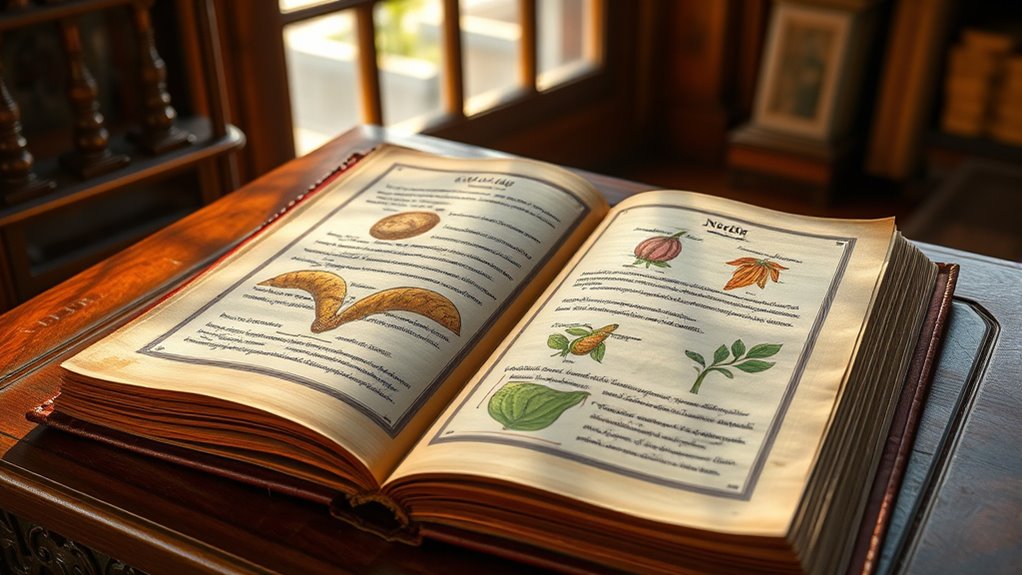
India’s ancient medical system, Ayurveda, boasts a rich collection of texts that serve as foundational guides for healing practices. Among these, the Charaka Samhita stands out as one of the earliest and most influential. It compiles detailed knowledge on herbs, diagnosis, and treatments, shaping Ayurvedic medicine for centuries. When you explore this text, you’ll discover:
Explore the foundational Ayurvedic wisdom on herbs, diagnosis, and holistic healing from the Charaka Samhita.
- An extensive classification of herbs and their medicinal properties
- Principles of balancing doshas for health
- Guidelines for preventive care and holistic healing
The Charaka Samhita emphasizes a thorough approach to health, blending herbs, diet, and lifestyle. Its teachings continue to influence modern herbal medicine and holistic therapies around the world.
The Greek and Roman Contributions: Pliny the Elder’s Natural History
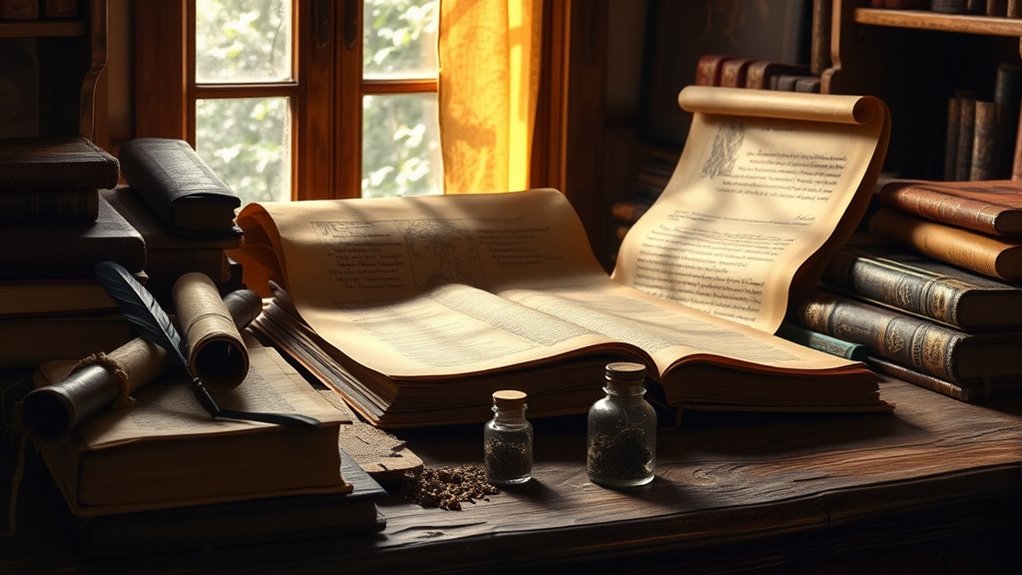
While exploring the foundations of ancient herbal knowledge, you’ll find Pliny the Elder’s *Natural History* stands as a monumental work from the Roman era that systematically catalogs plants and their medicinal uses. You see, this extensive encyclopedia covers over 20 volumes, detailing not just plants but also minerals, animals, and their applications in medicine. Pliny combines observation, tradition, and his own insights, making it a key reference for herbal remedies in antiquity. His work influences later medical texts, emphasizing the importance of natural sources for healing. You’ll notice that his descriptions often include preparation methods and effects, forging a link between botanical knowledge and practical medicine. Overall, *Natural History* shapes the understanding of herbal medicine for centuries to come, bridging Greek empirical methods with Roman systematic organization.
The Persian Influence: The Canon of Medicine by Avicenna
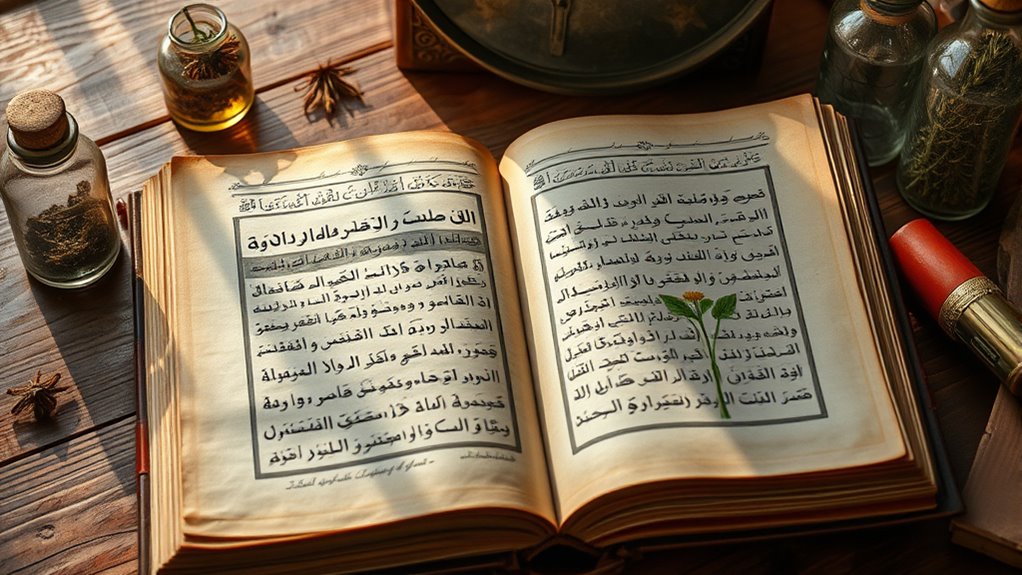
Here’s what makes it impactful:
- It standardized herbal descriptions, aiding accurate identification.
- It combined theoretical and practical herbal knowledge.
- It influenced both Islamic and European medicine for centuries.
Medieval Herbal Manuscripts and the Transition to Modern Pharmacology
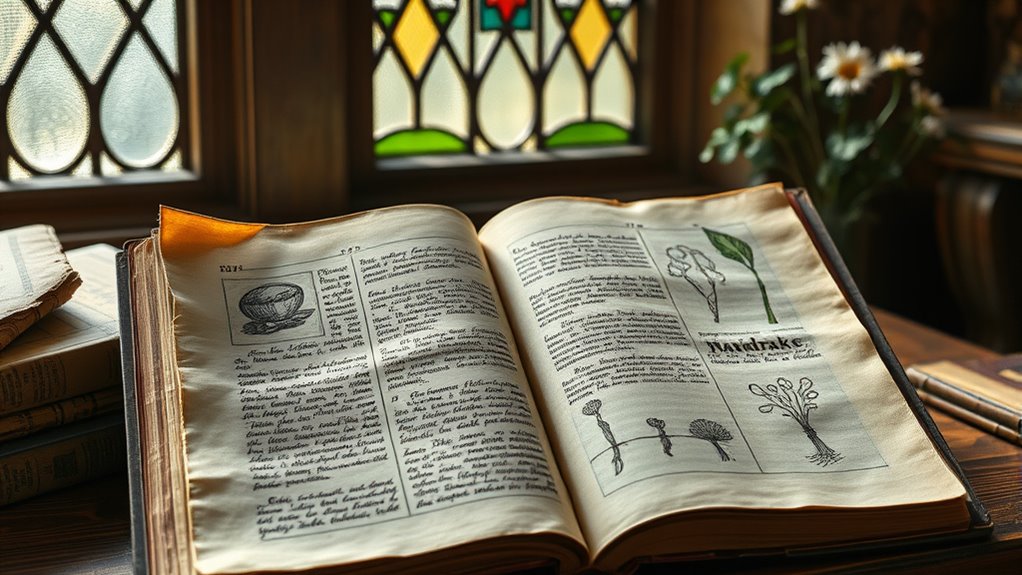
How did medieval herbal manuscripts pave the way for modern pharmacology? These manuscripts compiled detailed descriptions of plants, their properties, and uses, creating a foundation for scientific study. You can see how herbal knowledge was systematized, moving beyond folklore to more structured observations. Medieval scribes documented experiments, dosage guidelines, and preparation methods, which helped standardize herbal remedies. They often incorporated earlier texts, refining and expanding herbal knowledge. This progression from tradition to empirical observation sparked a shift toward evidence-based medicine. As you explore these manuscripts, you’ll notice the seeds of pharmacology taking root—highlighting medicinal compounds, observing effects, and experimenting with combinations. These efforts bridged ancient herbology with future scientific approaches, setting the stage for modern drug development.
The Legacy of Ancient Herbology in Contemporary Natural Medicine
Ancient herbology continues to shape contemporary natural medicine by providing a rich foundation of plant-based remedies and holistic healing practices. Today, you benefit from centuries-old knowledge that emphasizes balance, prevention, and personalized care. The legacy includes:
Ancient herbology offers timeless plant-based remedies and holistic healing for balanced, personalized health.
- The use of herbal formulas for common ailments, rooted in traditional texts.
- The integration of holistic concepts like energy flow and detoxification.
- The development of modern phytotherapy, which scientifically validates traditional herbs.
This enduring influence encourages you to explore natural options, blending ancient wisdom with scientific advances. By understanding these roots, you can make informed choices about herbal treatments and embrace a holistic approach to health that’s been refined over millennia.
Frequently Asked Questions
How Did Ancient Herbology Influence Modern Pharmaceutical Development?
Ancient herbology laid the foundation for modern pharmaceuticals by identifying plants with medicinal properties. You benefit from this history through the development of drugs like digitalis from foxglove and aspirin from willow bark. Researchers continue to explore natural remedies, isolating active compounds to create effective, targeted medicines. Your healthcare options are therefore deeply rooted in these ancient practices, blending traditional knowledge with modern science to treat illnesses more effectively.
What Are the Limitations of Ancient Herbal Texts Compared to Today’s Scientific Research?
You think ancient herbal texts are perfect guides? Think again. They lack rigorous testing, standardized dosages, and scientific validation, making their advice more folklore than fact. Unlike today’s research, these texts often rely on anecdotal evidence and superstition. You’d be taking a gamble trusting their claims without scientific backup. So, while charming, these texts are limited by outdated beliefs and the absence of modern scientific methods.
How Were Herbal Remedies Validated in Ancient Cultures Without Modern Testing Methods?
In ancient cultures, herbal remedies were validated through observation and experiential knowledge. You would notice how a remedy affected someone over time, noting improvements or side effects. Rituals, traditional beliefs, and community consensus also played roles in validation. While lacking modern scientific testing, these methods relied on accumulated wisdom, oral histories, and repeated success, which helped establish the effectiveness of herbal treatments for generations.
Are Any Ancient Herbal Formulations Still Used in Contemporary Medicine?
Yes, many ancient herbal formulations are still used today. For example, about 20% of modern medicines derive from plant compounds, including traditional remedies like ginseng and turmeric. You might find these herbs in herbal teas, supplements, or integrated into treatments. Their enduring popularity stems from centuries of traditional use and ongoing scientific research supporting their health benefits, making them an essential part of contemporary natural and alternative medicine.
How Did Cultural Exchanges Shape the Evolution of Herbal Medicine Texts?
Cultural exchanges profoundly shaped herbal medicine texts by blending different traditions and knowledge systems. You see, traders, travelers, and scholars shared remedies, ingredients, and healing techniques across regions. This exchange led to the integration of diverse herbs and practices into texts, enriching their content. As a result, modern herbal medicine reflects a global tapestry of healing wisdom, showing how interconnected cultures contributed to our understanding of natural remedies.
Conclusion
You can see how these ancient herbology texts still influence modern medicine. Imagine a patient today using a herbal remedy inspired by the Ebers Papyrus, feeling its natural healing touch. By understanding these historical roots, you appreciate the blend of tradition and science shaping your healthcare choices. These texts remind you that centuries of herbal wisdom continue to guide us toward healthier, more holistic healing methods.